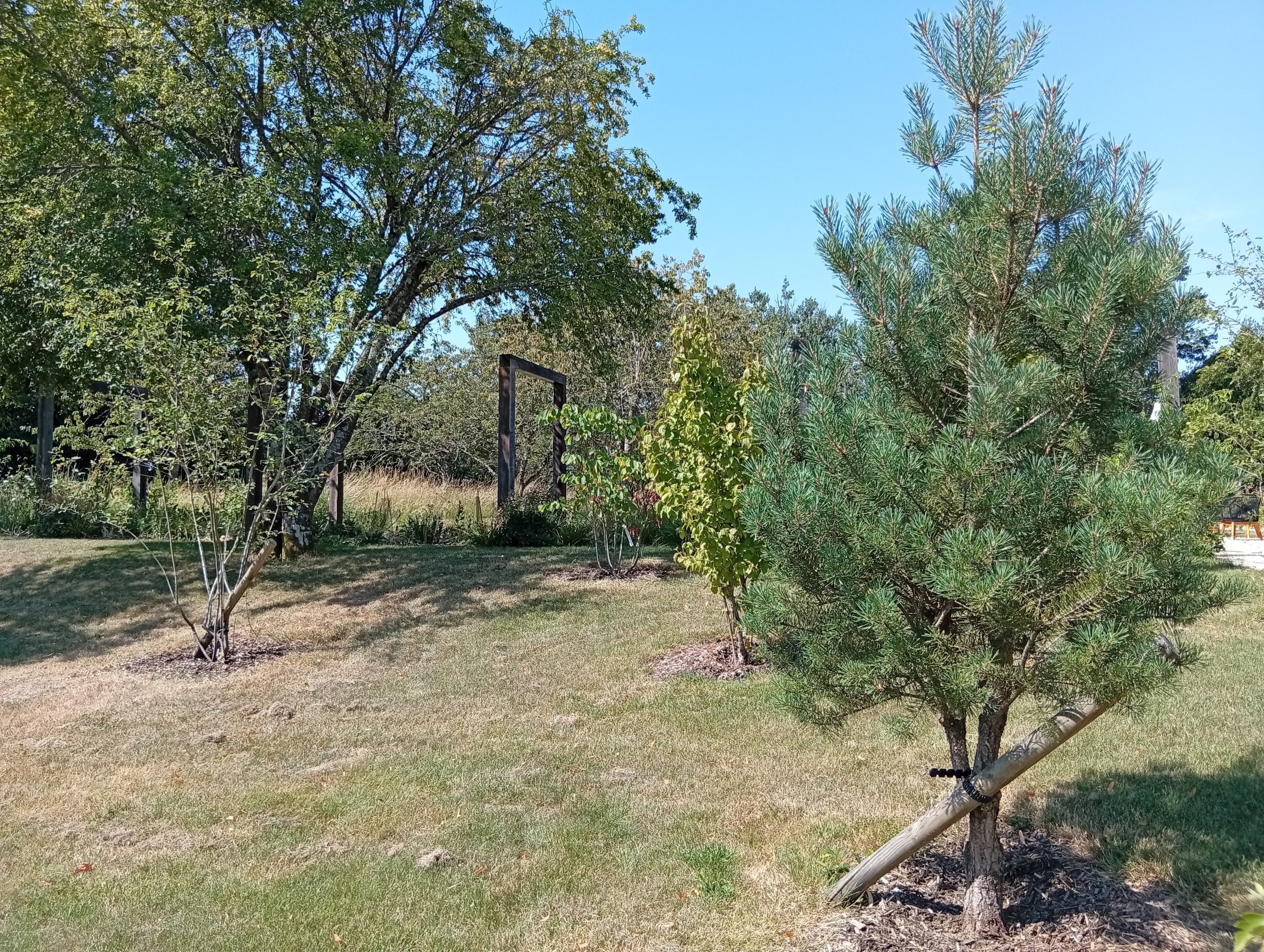
As our regional climate shifts toward more extreme summer peaks—with temperatures now regularly breaching the 40°C mark in the Vienne and Charente departments—the structure of our gardens must evolve.
While the “urban heat island” effect is well-documented in cities, rural areas around Civray experience a distinct version of this phenomenon. The vast, open agricultural fields that dominate our landscape offer little to no canopy cover. Once the summer crops are harvested or dried, these open expanses bake in the sun, generating massive pockets of trapped ambient heat. Without isolated pockets of dense forestry to cool the air moving across the plains, our residential gardens bear the full brunt of the heat wave.
While global climate targets look toward 2030 and 2050, local property owners need immediate, micro-climate relief today. The single most effective tool we have to lower ambient garden temperatures is the strategic introduction of mature canopy shade. Through transpiration—where leaves release moisture into the air—a single mature tree acts as a natural, zero-carbon air conditioning unit for your terrace or seating area.
For many clients, the hesitation to plant trees is time; no one wants to wait thirty years to enjoy the shade. Below is a curated selection of fast-establishing, structurally beautiful trees suited to our specific Poitou soils, alongside the precise methodology required to ensure they thrive.
Species Selection: Climate-Resilient Trees for the South Vienne

When designing a contemporary landscape in our region today, we must look past traditional palettes. The summers are visibly drier than they were even a decade ago. The species below are selected for their exceptional drought tolerance, structural beauty, and ability to thrive in our challenging Poitou soils without requiring artificial irrigation once established.
| Species | Form & Aesthetic | Micro-Climate Function | Soil & Resilience |
| Acer campestre (Érable champêtre) | Compact, dense canopy; stunning clear yellow autumn color. | Fast shade producer; excellent structural or hedge element. | Highly drought-tolerant; thrives in tough limestone and heavy clays. |
| Pinus sylvestris (Pin sylvestre) | Pictorial, twisting orange-red bark; structural evergreen canopy. | Perfect architectural focal point. Use cultivar ‘Watereri’ for compact spaces. | Exceptional drought resistance; loves poor, well-drained soils. |
| Fagus sylvatica (Hêtre) | Crisp, clean architecture; coppery leaves that often hold through winter. | Deep, cool shade. Can be precisely clipped for sharp, contemporary lines. | Deep rooting; highly resilient once established in Vienne loams. |
| Cornus mas (Cornouiller mâle) | Explosion of yellow spring blossom before leaves; structural multi-stem. | Brilliant for smaller courtyards or framing the edge of a sunny terrace. | Tough as nails; effortlessly handles baking heat and dry chalk. |
| Crataegus monogyna (Aubépine / Hawthorn) | Rugged, twisted habit; rich wildlife value with masses of white spring blossom. | Tough, architectural specimen tree or part of a structural boundary. | Indestructible in dry, exposed, sun-baked rural fields. |
You will notice the absence of regional favorites like Silver Birch (Betula utilis) or Juneberry (Amelanchier) from my modern designs. Experience over the last eight years has shown that unless these species are sited in a natural dip or an uncharacteristically damp pocket of the garden, they simply can no longer tolerate our intense mid-summer soil dehydration during establishment.The Engineering of Planting: Maximizing Root Establishment
The failure of a new tree during a hot summer is almost always traced back to poor planting or irrigation technique. To guarantee a tree establishes deep, resilient roots that can hunt for water during a drought, follow this structural methodology:
1. Stock Selection & Timing
Whenever possible, utilize bare-root trees (racines nues). These are only available from reputable local nurseries from November through late winter. Because they are grown directly in the field without the constrictions of a plastic pot, they establish a symbiotic relationship with your garden’s native soil far more rapidly than container-grown alternatives. They are often smaller than container grown plants, but this is to their advantage: once established their growth rate accelerates so that they often overtake their container grown counterparts.
If you must plant container stock during the rest of the year, prepare for an intensive, non-negotiable irrigation schedule throughout the late spring and summer months to prevent the root ball from baking dry.
Biosafety Note: To protect our local landscape from imported pathogens, always ensure your nursery provider supplies a phytosanitaire passport with the stock.
2. The Square Hole Technique

As shown in the above image, when preparing the ground, dig a square hole rather than a traditional circular one. The hole should be two to three times wider than the root ball, but exactly the same depth.
When structural roots grow outward and hit the flat, angular edges of a square hole, they are forced to venture out into the surrounding native soil. In a round hole, the roots tend to follow the curve, spiral around the root ball, and eventually strangle the tree.
Break up the soil at the base of the pit to allow downward penetration, but do not loosen it so deeply that the tree subsides over winter. The soil line on the trunk must remain exactly level with the garden grade.
3. Backfilling and Mycorrhizae
Introduce mycorrhizae fungi directly to the root system during planting to dramatically accelerate nutrient uptake. Backfill the hole using the native soil dug from the pit—do not add rich commercial compost to the hole. If the soil inside the hole is radically different or richer than the surrounding ground, the roots will refuse to leave the pit, creating a weak, unstable root system. Firm the soil gradually with your heel as you backfill to eliminate air pockets.

4. Low-Staking and Protection
For trees taller than 1.5 meters, secure them using a low-stake method. Anchor the stake at an angle into the prevailing wind, securing the trunk roughly 1 meter from the ground with a flexible rubber tie. This leaves the root ball completely immobile (preventing root tear) while allowing the upper canopy to sway naturally in the wind, which stimulates the tree to produce lignin and strengthen its own trunk.
Finish with a heavy mulch layer or a pegged jute mat to suppress weed competition and lock in ground moisture, but do not allow it to pile up against the bark of the tree or shrub. Keep the trunk clear of mulch. If rabbits or deer are present locally, a rigid guard is essential to protect the lower bark.
Local Planning & Boundary Regulations (Urbanisme)
Before breaking ground on any significant planting scheme, you must adhere to the standard French civil code regarding boundary distances (Code Civil art. 671), unless your local Mairie or PLU (Plan Local d’Urbanisme) dictates stricter rules:
- Trees, shrubs and hedges intended to exceed 2 meters in height must be planted with the center of the trunk at least 2 meters away from the property boundary line.
- Trees, shrubs and hedges intended to be kept 2 meters or under in height require the centre of the trunk to be a minimum distance of 50 centimeters from the boundary line.
Critical Aftercare for Drought Resilience
During the first three seasons post-planting, irrigation must be deliberate and heavy. A light sprinkle with a garden hose does more harm than good, encouraging weak, shallow root growth that burns instantly in a heatwave.
During hot periods, deliver three to four heavy watering cans (approx. 40–50 liters) weekly per tree, poured directly over the root zone. This volume forces water deep into the lower soil strata, training the root system to grow downward toward the natural water table, ensuring the tree is entirely self-sufficient within three years.
No responses yet